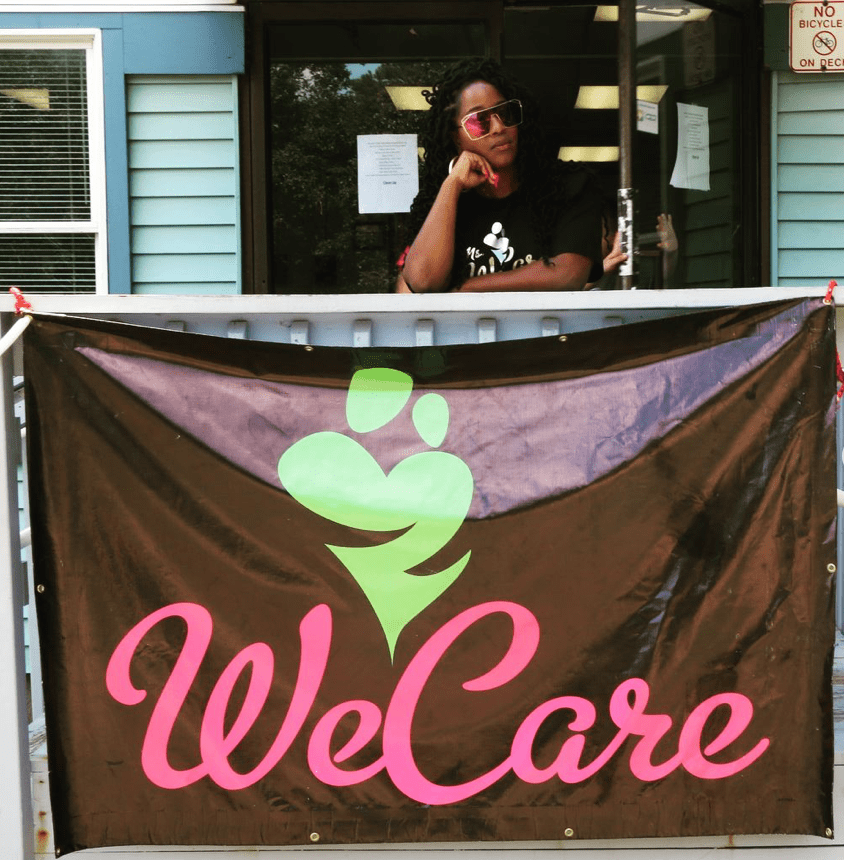
WeCare, a nonprofit organization in Cumberland County, New Jersey, that’s dedicated to youth empowerment, is one of the many nonprofits and small businesses struggling to stay afloat during the current pandemic.
Many people living in the small South Jersey county where WeCare is based is familiar with the organization’s pink and green logo, it’s Thursday night “Youth Nights” and annual Community Fun Day that brings the whole county together. WeCare was founded in 2013 by Cumberland County resident Brenda Phillips, 32, under the mission statement “making an impact on the youth of today, so that they may contribute to to the youth of tomorrow.” Over the past seven years, WeCare has fulfilled that mission statement through exposing Cumberland County youth aged 11 to 18 to recreational fun, a constructive environment where they can interact with their peers and a chance to build and essential relationship with a mentor. The nonprofit has taken Cumberland County youth on college tours, sponsored 10 girls to go to the Uniquely You Summit, does annual prom dress giveaways and toy drives, taken youth to volunteer at homeless shelters near the area and so much more.
Phillips said her past made her want to start this organization.
“I grew up without my parents, with little to none guidance. I could’ve became a product of my environment but I was lucky enough to not fall victim to that. I don’t want any child in our County to feel lost or like they have no one in their life that supports them,” she said.
She continues with sharing some of the issues the organization has been having because of Covid-19.
“Sadly, WeCare has become pretty much inactive this past year. Funds are low, we couldn’t even do our annual college tour because of Covid. And of course I can’t host my Thursday night Youth nights anymore because the MLK Center is limiting its program events. I miss spending my Thursday nights at the center with my kids, a lot of them really would look forward to it,” she said.
The “MLK Center” that Phillips references is the Martin Luther King Community Center located in Newtonville, just outside the county. The Center is home to the African American Heritage Museum of Southern New Jersey and has provided a space for community events such as WeCare’s Youth Nights— an after-school program where youth of the community would convene and engage in different activities and group discussions.
Pre-pandemic, the center would have a calendar rife with activities that community members could come and enjoy. However, the only activity that the center is allowed to host is its bi-weekly food bank “drive-ups.”
Quentin McClendon, the center’s director expresses his disappointment for having to stop WeCare’s Youth Nights.
“It’s unfortunate that we had to stop our staple events like WeCare’s Youth Nights and our Friday night Zumba classes. We have restrictions to follow and a responsibility to our community to keep everyone safe. The only services we are facilitating now are essential ones that can be done through minimal contact.”
He goes on to reference an essential service like the center’s food bank “drive-ups” that provide meals to families in the county.
As shown, just as it has affected many other aspects of daily life, Covid-19 has disrupted WeCare’s goal and mission statement as a nonprofit.
J. Clinton Mabie, the president and CEO of the Tucson-based Community Foundation for Southern Arizona (CFSA), writes in Inside Tucson Business and puts the current reality for nonprofits like WeCare bluntly.
“The impact of Covid-19 on the nonprofit community is unprecedented. It has affected the capacity and sustainability of every nonprofit—from education to the environment, affordable housing to mental health services, animal welfare to the arts—no organization will emerge unscathed.”
The aspect of nonprofit work that WeCare functions under is community engagement. ACT (Assets Coming Together) for Youth Center for Community Action, a nonprofit youth research organization defines youth engagement as the result when young people are involved in responsible, challenging actions to create positive social change— a central principle of youth development.
When connecting this to the work that WeCare does for the community, it can be deemed an essential organization due to it being a facilitator of youth engagement and essential for youth development.
The Marguerite Casey Foundation, a private grant making foundation, did a study that highlighted the reason why organizations like WeCare are so important. Nearly 1 in 7 young people ages 16 to 24 are disconnected—neither working nor in school; and nonprofits like WeCare work to draw that connection. WeCare’s mission to mold young people into leaders is consistent with the outcomes of youth engagement. WeCare works towards developing the capacity of young people as leaders and decision makers and towards cultivating a strong and inclusive economy. The study also reports that youth engagement improves employment outcomes and increases educational attainment in communities that provide resources for youth engagement. Tamia Langford, 20, a Sicklerville, New Jersey, resident who was a member of WeCare from the age 13 to 18 explains how the organization was essential to her development as a teenager.
“I never would’ve visited Morgan State and ended up choosing that college if it wasn’t for Ms. Brenda… I’m so involved in the MLK Center’s food bank drives only because of WeCare and Ms. Brenda exposing me to volunteer work.”
Cumberland County is a community that thrives because of its small businesses and nonprofit. Due to COVID-19 organizations like WeCare do not have the means or capacity to safely provide the same services they did post-pandemic, and that in turn is affecting the County as a whole. If WeCare and other organizations alike cannot fully operate, what will the future of youth engagement look like?
 In Black and Write