Long before Covid-19 uprooted the U.S. education system, schools around the country were experiencing alarming achievement gaps between minority/low-income students and white/high-income students. Now, these achievement gaps are widening as Covid-19 is disproportionately impacting low-income communities of color.
These gaps in achievement form as soon as a child enters the U.S. education system. The American Psychological Association (APA) reported that at a young age a child’s initial reading competency is correlated with the number of books in the household, home literacy environment, and parent concern for the child’s development. Children who come from poorer households have less access to books and other learning materials to help build their initial reading competency. Children that come from low-income, predominantly minority neighborhoods, have fewer library resources and schooling conditions than high-income neighborhoods, affecting their ability to develop reading competency at a young age. These factors that hinder a disadvantaged child’s academic progress have been shown to follow them through secondary school. Students from low-income families enter high school with average literacy skills five times behind students that come from high-income families. These setbacks can affect an adolescent’s high school academic success, and motivation to complete high school. In 2019, the high school dropout rate among persons 16-24 was highest among low-income families, compared to high income families; as well as highest among racial minority students compared to white students.
These disparities in educational achievement and attainment between minority/low-income students and white/high-income students have become even more apparent and significant due to the effects of Covid-19. According to a report done by CNBC, more than half of public school K-12 teachers said the pandemic resulted in a “significant” learning loss for students—academically and in their social-emotional progress. The study also showed that more than 97 percent of educators reported seeing “some learning loss in their students over the past year when compared with children in previous years.” Black and Hispanic students are most impacted, as research also shows that distance learning has caused a significant setback in achievement for students of these backgrounds. This disproportionate negative impact of virtual learning on low-income/minority students is especially alarming for majority low-income schools like Vineland High School in Vineland, New Jersey.
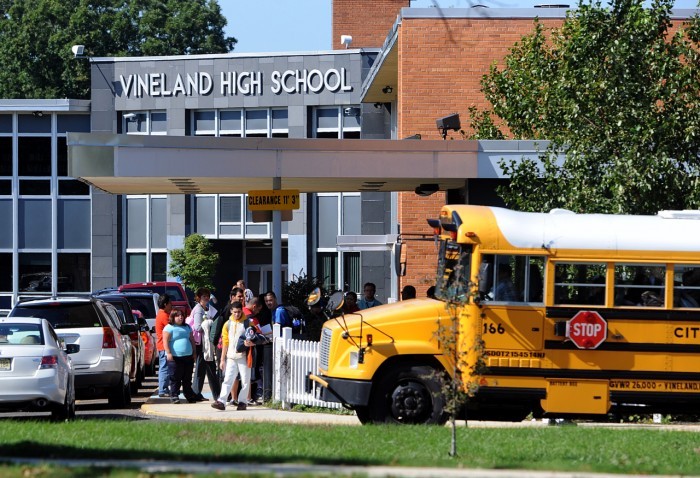
Vineland High School is located in the largest city, in the poorest county in New Jersey. With approximately 2,500 students, and a population consisting of 53.8 percent Hispanic, 23.7 percent white, and 18.4 percent Black students. Additionally, about 62 percent of the city’s high school students are defined as “economically disadvantaged.” Also, according to the 2020 New Jersey School Performance Report, about 62 percent of students receive free or reduced lunch because their families earn at, or below, the U.S’s Department of Agriculture income eligibility guidelines. These statistics would characterize the school as a low-socioeconomic (SES) school. To answer the question as to how the school’s SES is affecting student academic performance, the NJ Department of Education utilized District Factor Groups (DFGs). DFGs are indicators of SES in districts of schools and use data from decennial censuses to hypothesize how SES is affecting schools in comparison to others. Using data from the 2020 Decennial Census, DFG’s concluded that in Vineland, student performance is affected not only by the quality of the educational services received in the school, but also by student’s parents’ SES.
Minority students at Vineland High School expressed that they are experiencing a significant number of stressors due to Covid-19 and the switch to online learning. The senior counselor at Vineland High, Elyse Matriccino, cites the depleting attendance rate when explaining why it is plausible to say that distance learning has caused a significant setback in achievement for students low-income/minority students at the high school.
“The guidance department has been working closely with the school superintendent to try to figure out a way to motivate students to attend class, whether it be virtual class or in person…. In September 2020, the daily attendance rate hovered around 87 to 88 percent, but it has been dropping ever since…. Now I’m afraid it’s around 77 percent,” said Matriccino.
With most of the school’s student population being minority/low-income, it’s plausible to say that this dropping attendance rate is a reflection of how COVID-19 is widening academic achievement gaps between students.
Many schools across the country, including Vineland High, created a type of hybrid plan where students could start coming back to campus for in-school learning. In order for any student to benefit from remote learning, reliable internet and technology is essential, as well as a proper and supportive at-home learning environment. Data from the United States Education Department showed that more than nine million students between the ages of 3-18 do not have internet access at home; only 12 percent of white children lack internet access, compared to almost 20 percent of Black children. These numbers could also explain the reason why only 60 percent of low-income students are regularly logging on for virtual learning, compared to 90 percent of high-income students; and also why in schools with predominantly Black and Hispanic students, only 60-70 percent of students are regularly logging on for virtual instruction. In October, more than 60 percent of Vineland Public School students went back to school for in-person learning, starting out with two four-hour sessions per week. However, many students remained home, including honors student, Vineland High senior, Cesar Ramirez, 17.
Ramirez has two younger sisters who attend a public elementary school in Vineland. His mom is the main supporter of all three of them while working full-time at the local hospital. Throughout the early afternoon his mom is working, causing him to have to be the one helping his younger sisters with their online schoolwork and keeping them on task. For this reason, he is unable to be a part of the students who went back to in-person learning at Vineland High.
“Personally it hasn’t been hard to stay on top of my grades and everything but I wish I could be in school for four days out of the week… I would be way more focused on myself and not everything going on at home,” said Ramirez.
The “digital divide” has proven to be an issue for some Vineland High students as well. The digital divide, or the gulf between those who readily have access to internet and technology and those who do not, is important to consider when trying to conceptualize why Vineland High’s attendance rate is depleting, as Matriccino stated.
Jaida Phillips, 17, a junior at Vineland High, is one of the many students who did not have access to reliable technology or internet when the school first moved to online learning. Vineland High did try to accommodate students who didn’t have access to a laptops by administering Chromebooks to any student who needed one; however, no accommodations were made for students who did not have access to reliable internet.
“It took a while for the school to give me a Chromebook to do my school work on… in the beginning of the school year before we were able to go back to in-person classes, I missed online class a lot… my wifi wasn’t stable and the Chromebook didn’t come until October,” Phillips said.
Phillips also expresses how unlike Ramirez, she had to go back to in-person learning when her school opened back up again in October. Her internet was too unstable and her household did not provide an adequate learning environment; the better option for her was to go back to in-school learning, even though she would have preferred not to.
In past years, Vineland High has already struggled to meet the New Jersey academic performance targets. The school did not meet the annual state target for the 2018 graduation rate, nor did it meet state standards for the PARCC test, the NJ standardized test. Now as Covid-19 widens the already large academic achievement gap between minority/low-income students and white/high-income students, it is apparent that the school’s minority population is falling behind. The School’s 2020 Academic Performance Report was released in April 2021. The report showcased how only 49.6 percent of 2019 graduates enrolled in a college or university by fall of 2020, while the state’s percentage was 76.3 percent. Vineland High also had a 2020 graduation rate of 80.5 percent, not meeting the state target.
 In Black and Write