After the 2020 holiday season passed, many small businesses experienced a surge in profits and ultimately were able to make up the revenue they lost during the height of the pandemic, as reported by the Daily Journal in Vineland, New Jersey. However, to be able to do so, they had to first make necessary pandemic-related pivots and adjustments to stay open and provide services to their customers.
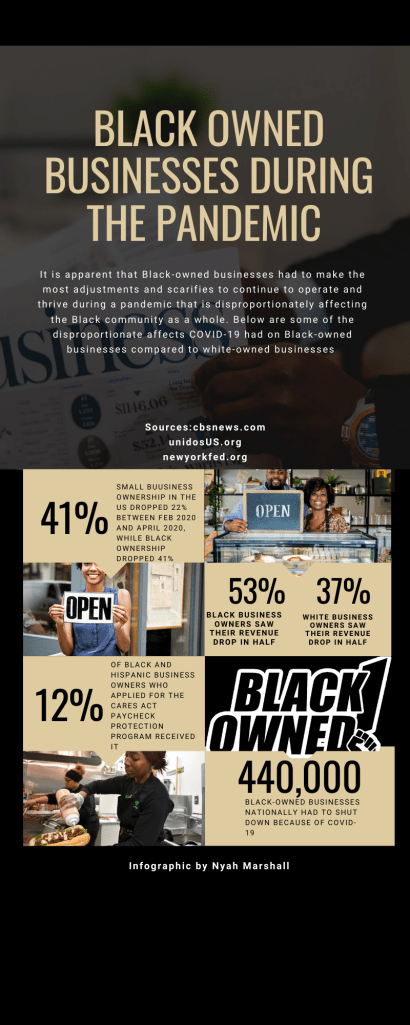
It was especially important for Black-owned businesses to change the way they operated in order to stay afloat amid Covid-19 surges this past year. This is mainly due to the fact that Black-owned businesses were hit the hardest by the pandemic. According to a study done by H&R Block on small businesses, “53 percent of Black business owners saw their revenue drop by half, compared to 37 percent of white owners, since the pandemic started.”
Two Black business owners in Vineland, New Jersey, were among the percentage of Black business owners who saw their revenue drop since the beginning of the pandemic. Soroya Crawford, 31, the owner of Pretty on Purpose in Vineland, and Sharonda Harris Bunton, 35, the owner of Vegans Are Us in the city, both reported struggles consistent with the ones Black-owned business owners around the nation experienced.
Many small businesses in Vineland reside on Landis Avenue, the city’s most vital downtown area. Vineland is known for its small businesses; some which have been around since 1942.
“Small business survival is tough every year… but this year our small businesses found a way to either reinvent themselves, to adjust, or cut expenses,” said Robert Scarpa, Vineland Downtown Improvement District business development director.
Scarpa said none of the 40-plus Landis Avenue small businesses had to shut down for good because of the pandemic.
“That alone speaks to the spirit of Vineland and our small business owners,” Scarpa said.
This past year alone, 13 new businesses opened up on The Ave including Buy A Thread, Marcia Taylor, Our Place, and Soroya Crawford’s Pretty on Purpose.
Pretty on Purpose is a party-themed women’s clothing store that offers a wide range of custom apparel items, jewelry, gifts, accessories, and more.
“You’re guaranteed to leave the store with a smile,” said Crawford.
It was daunting of Crawford to open her store in Nov. of 2020, during a time when so many small businesses, especially Black-owned businesses, were struggling just pay their employees.
“God told me it was the right time and I took advantage of it. It had been a dream of mine to open this business since I graduated college and I wasn’t going to let the pandemic stop me,” Crawford said.
While her faith and passion for her business motivated her to keep Pretty on Purpose up and running, she still was presented with a multitude of challenges.
Part of the struggle for Black businesses during this time came from their difficulty securing bank loans during the first wave of the pandemic, many even reported being left out of the Paycheck Protection Program.
The Paycheck Protection Program is a federal lending initiative geared to smaller employers. It was launched through the CARES Act to help certain businesses, self-employed workers and certain nonprofit organizations to continue to pay their workers.
Crawford applied for the first-round of loan applications in April 2020, but was denied. Only 12 percent of Black and Hispanic business owners who applied for the low-interest loan under the CARES Act received it, according to a survey from racial equality groups Color of Change and UnidosUS.
Regardless of this setback, Crawford was able to continue to operate Pretty on Purpose throughout the first and second wave of Covid-19 and thrive during the 2020 holiday season. To do so, she had to make some changes. At Pretty on Purpose, Crawford shifted her store stock away from party fashion since many of her customers were staying at home due to lockdowns. Now, the store racks are filled with soft sweaters and cozy tracksuits for comfortable lounging. To try to eliminate long shipping delays, Crawford no longer works with overseas suppliers, but instead deals with U.S. vendors. Pretty on Purpose’s online presence has also increased.
“I posted on Facebook more and after posting Pretty on Purpose on a Facebook page promoting Black-owned businesses in Cumberland County, I would get customers from everywhere. I had a customer who traveled two hours to buy something from the shop,” she said.
Vegans Are Us, the only vegan soul food restaurant in Cumberland County also resides on Landis Avenue. Owner Sharonda Harris Bunton was forced to make several changes to her business after New Jersey Gov. Phil Murphy put strict relations on restaurants during the first wave of COVID-19.
In March 2020, Gov. Phil Murphy’s decision to shut down most small businesses and the halting progress in reopening them affected restaurants like Vegans Are Us. Michele Siekerka, president and chief executive officer of the New Jersey Business and Industry Association said a survey of her membership indicated that almost half of New Jersey small businesses expect to need a year to recover.
Before Vegans Are Us announced that they were able to do in-house dinning starting September 4, the business, like many restaurants, was only doing takeout and delivery services.
“Vegans Are Us experienced a loss in revenue and traffic of about 25 percent during the first stages of the shutdown… we had to figure out a way to adapt which is why we started doing delivery services through GrubHub,” said Bunton.
Even after Bunton’s business opened for in-house dinning, the restaurant still had to make many changes. For instance, they were able to have inside dining, but only at a 25 percent capacity, they implemented an hour cap for each party and also set up a QR code at each table so customers could view their menu right from their phone.
Like Crawford, the pandemic motivated Bunton to elevate her business’ online presence. This past fall, Crawford hired marketing expert Mary Linen, who has worked with Daymond John of the #FUBU brand, and Shark Tank fame. Linen is the head of Vegans Are Us’ marketing team and has launched several social media initiatives throughout the pandemic to gain traffic to the restaurant.
For the restaurant’s one year anniversary in November, on Facebook the business stated that they’ll take 30 percent off customers bills’ when they come in and show the mentioned social media post. Also, in response to the death of George Floyd, the restaurant posted on their Instagram that they would take 10 percent off of customers bills’ if they donated to the mentioned Black Lives Matter local organizations.
“Vegans R Us gained over 1,000 followers from November 2020 to April 2021…. We now have a total of over 4,000 followers on Instagram and over 2,0000 likes on Facebook,” stated marketing director Mary Linen.
Vegans Are Us’ success throughout the pandemic can be attributed to their growing social media presence, support from the community, and the current social climate.
“Africans Americans are the fastest growing demographic of vegans in the United States and we are also the most affected by the pandemic in many ways. I think business has picked up these past few months because of this. Our people want to be healthier,” said Bunton.
Bunton and Crawford were able to make a comeback after the lockdown and come out of the height of the pandemic successful. However many Black-owned businesses weren’t able to do that as The Federal Reserve Bank of New York found that small business ownership in the U.S. dropped 22 percent between February 2020 and April 2020, but Black ownership dropped 41 percent— “the greatest decline among all racial groups during the depths of the pandemic.”
 In Black and Write